
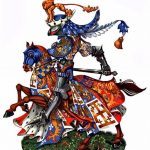
Our August ’24 meeting was an introduction to Heraldry by Mike Rumble, Chairman of The White Lion Society which produces a quarterly newsletter edited by Mike, on all matters concerning Heraldry. There are two societies concerned with Heraldry – The Heraldry Society (concerned with education and charity) and The White Lion Society. Both are affiliated to H.M. College of Arms. Dan Escott was a renowned Heraldic artist responsible for the splendid Equestrian Knight and the Arms of Chichester which first appeared in Look and Learn Magazine.
We learnt that the colours in Heraldry are called Tinctures and feature the five primary colours and two metals, silver and gold.
The history of Heraldry goes back to 1066 when Norman battle shields were blank and it was hard to know who was ‘friend or foe’. By the time of Agincourt colours and banners were being carried into battle. Heralds first began to record Arms at medieval jousts . The Dering Roll (1270-80) listed over 300 Coats of Arms and The Coronation Roll (in the National Archives and online) records those attending, with heraldic embellishments, and the proceedings of the Coronation of King Charles 111.
Many famous people had their personal coat of arms e.g. Admiral Lord Nelson, and the Duke of Wellington. Also, from 1439 corporations, civic authorities and organisations developed coats of arms. e.g The Thames Traditional Rowing Association. Mottoes became a feature, often in Latin, and were added to the lower part of the design.
Mike talked about the vocabulary around the design elements of coats of arms – the Crest (above the helmet), Wreath (to protect from sun), Helmet, Shield, Charges (what is on the shield), Motto (usually Latin, French or English), and Blazon (the description of a coat of arms).
The process of applying for the granting of a coat of arms takes about 2 years and ends with the production of a document on vellum and costs about £9,000 + £2,000 for an additional badge and banner, which can be passed on to descendants.
Mike mentioned some interesting celebrity coats of arms e.g. James Bond’s featuring the Bond family motto “The World is Not Enough” featured in a film clip from On Her Majesty’s Secret Service , The Armscommissioned by the Beatles Manager George Martin, featured only 3 Beatles ,a guitar fret and the famous Abbey Road crossing. Tesco’s features a purse and badger ( representing Good Housekeeping).
Elizabeth 11 (EiiR) and King Charles 111 (a large C with R overlaid & numeral 111) have Royal Ciphers as do the Armed Forces (RAF & Royal Navy) in the form of cap badges. The Royal Ladies also have Coats of Arms (e.g. Camilla & Countess of Wessex).

City of Chichester Coat of Arms
The Sussex coat of arms features six Martlets (could be swallows, swifts, or house martins) which represent the six districts (Rapes) of Sussex. The Chichester Coat of Arms goes back to 1570 and features the Royal Lion, and red drops of blood, presumed to represent the sacrifices made by Cistercians over time. Bringing us up to more recent times, The British Olympic Association commissioned a Coat of Arms in 2016 for competing Team GB athletes which could be spotted discreetly worn on kit at the 2024 Paris Olympics.
This was a fascinating talk on a subject most of us knew little about. The numerous and colourful slides added greatly to our understanding of the design elements behind the creation of Coats of Arms, Banners and Ciphers.
Lois Coulthart